KS3 Subject Intent
Music can be separated into three different disciplines – Performing Music, Composing Music, Listening & Appraising Music. The three branches of Music are taught and developed together with the aim to build personal skills that students can draw upon to succeed, not only in music lessons but also beyond school life and in future employment.
The life skills that are developed, and are at times explicitly taught, are an integral part of the development of the subject specific skills as well as creating well-rounded individuals. The core principles that are developed would include: Problem solving, perseverance, diligence, team work, time management, organisation, responsibility, cultural history, listening skills, confidence, social skills, discipline, self-evaluation, interpersonal skills, sense of achievement. This is considered important as primary data shows that little music work has been experienced at KS2 and these skills have not been developed. Opportunities are embedded for students to be able to hone and develop the practical aspects of performance and composition, but equally important is the ability to understand how the development of life skills, such as confidence, self-awareness, perseverance and discipline give them a holistic experience that they can take beyond their musical studies.
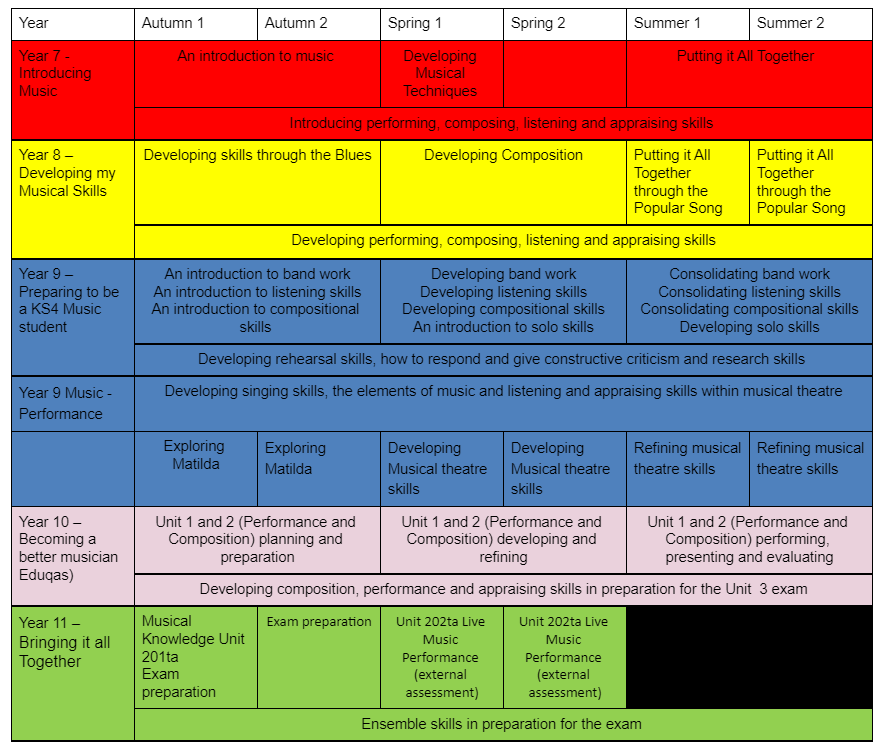
The KS3 curriculum is structured based on the expectations for BTEC Tech Award in Music Practice; key concepts and skills required by the end of these courses are fed down into schemes of work from Year 7 upwards. This is designed to raise expectations and standards from the start of Key Stage 3 and ensure that musical knowledge is being understood both practically and theoretically. Year 7and 8 will study various musical genres, (historical and cultural) and through these different cultures and styles will explore, develop and refine their musical skills. Each project will focuses on performance or composition, so that over the key stage students will return to these concepts enabling them to build and advance their knowledge and skill set further as the progress through the Key Stages.In Year 9 all students follow a music performance programme consolidating the key concepts learnt during Years 7 and 8 through the study of musical theatre. Singing is a prominent feature. Homework tasks are used to extend listening and appraising skills and extend knowledge.
KS4 Subject Intent
The KS4 curriculum intends to build on the 3 main disciplines outlined in the KS3 whilst meeting the BTEC Tech Award in Music Practice. This provides a curriculum based on the study of musical genres and creating musical products.
Like KS3 the key skills, both musical and the core principles, are embedded, leading the student to a love of music that will allow them to successfully continue their studies to KS5 if they so wish. One of the main techniques learnt is constructive criticism as students are encouraged to always want to improve and be their best.
The curriculum is supported by free instrumental tuition and a variety of extra-curricular clubs and opportunities in order to provide an extension of the curriculum.